Showing posts with label self-hate. Show all posts

The cycle of internalized racism continues


Each time I hear someone complain, "Well, black people say the N-word. Why can't I say the N-word too?" It always sounds to me like, "You engage in self-harm. Why can't I cut you too?" Unfortunately not enough of my fellow AAs hear this as well. Instead, too many of us view the N-word as some sort of privileged that we can say simply because we are black. In any case, what caused me to think about this today was a quite shocking episode of America's Supernanny, which you can watch in full here. The subjects of the episode are an family of 10 kids (with two more on the way), the Carzells. Needless to say, they are out of control, which is rather remarkable in itself. However, their behavior does not compare to the racism that quickly spews from the children's mouth toward their 9 year-old sister Nevada. (This conversation starts at 7:30)

"That girl got something going on with her skin," Desja says, "She is dark!" All Nevada's sisters all begin to laugh at her. "You're the darkest person [in the room], so get out!"
Her brother shouts, "She took a shower yesterday, and she's still dark!"
"That's why no one ever knows where you are," Desja continues, "and every time we're at the store, you always get lost, because you're so dark."
"You is burt! You look like a gorilla."

Later Deborah Tillman (the Supernanny) confronts Desja about why she attacks her sister for being dark.
"Nevada was talking about everyone else," she says. "My mom was like, 'Nevada stop talking 'cause you're the darkest in this family."

This attitude is perpetuated throughout our community. Often, I see AAs highlighting racism coming from the outside. However, the outrage that comes when racism comes from someone who is not black is absent when a fellow AA is racist, which is why we have this absurd notion that it is okay for a fellow AA to say the n-word. "Oh, a Caucasian can't cut us, but we can hurt ourselves." As long as this attitude persists, with or without systematic racism, we will always keep ourselves down. It will only be changed when we start holding a AA who is racist accountable, just as we would if a Caucasian were to us. I don't care if you're black, you do not have a pass to be racist.

African-Americans supporting racism and ignorance


I just read this article about Lil Wayne’s hatred of dark skinned women. Now, I don’t care about Lil Wayne nor his statements (as I’ve never listened to his music or that of any other rappers, for that matter), and I won’t discuss the irony of his disgust for dark women, considering that he is dark himself. Also, I’m not surprised by his comments as I’ve heard rappers say similar things. However, I am disappointed that when they make such statements, AAs not only do not bat an eye but continue to lap their music up. If anyone of European descent said that we were ugly or inferior in anyway because of our skin color, AAs would be appalled, yet they throw millions of dollars toward rappers who only demean our worth and refer to us as "bitches" and "hoes". How oblivious are we that we actually pay someone to insult us--especially AA women who idolize singers and other celebrities who have a paper bag test for the women they associate with and allow in their videos? I will not expect the conditions of African-Americans to change in this country while we continue to oppress ourselves. As long as we, and the people that we esteem, associate our worth to the color of our skin and the texture of our hair, the problems that plague our community will continue to persist.

Another reaction to Lil Wayne's statements that I find quite irritating are some people’s dismal of them as just a preference, as if our “preferences” just arise from nowhere and are therefore trivial. We are all aware of the racial hierarchy in this country from when we are just children. These “preferences” of men are merely the racism they learned during childhood manifesting itself when they are adults. We can’t remedy problems when we will not even acknowledge that they exist. The more that we have discussions about colorism, the more likely it is that people will confront the self-hatred and internalized racism that fuels their biases toward skin color. 

African-Americans embrace all that is negative and destructive

They walk down the path of self-destruction...obliviously?

I was reading Clutch Magazine and was struck by an article talking about a writer at Grazia Daily UK describing afros as "ghetto fabulous." I hate hate hate when the word "ghetto" is used as a synonym for African-Americans, and even though I felt motivated to lash out at Caucasian ignorance, I realized that we share a significant part of the blame. It has become part of our culture to embrace and internalize negativity. It is as if we have a campaign to "claim" everything that is bad. We were called "nigger,"so instead of stomping our foot down and proclaiming, "No, I am too a man" we feel the need to "take back" the word. American's dehumanization of us caused us to be in poverty, but instead of saying "I am going to fight out of this quagmire," we accept the ghetto as our home and see it as something to be celebrated. I searched "ghetto" under song title at EndlessLyrics.com and found 108 songs glorifying life in the ghetto! Dang, it's like James and Florida fighting their whole life to get out of the projects just for J.J., Themla, and Michael wanting to stay in. How African-Americans have become so content with being third class citizens is beyond unsettling. How can we get ahead when we glamorize poverty and crime--when we don't even see that we are in trouble in the first place? That is what separated the African-Americans in the 60s and earlier from us today. They recognized they were drowning and were desperate to know how to swim. People to day have their head underwater but are too ignorant to fight to keep their head above. It is as if we look at others, such as our president and the prominent figures in African-American History Month, and use them to delude ourselves that we have equal status. Is it that our eyes are so focus on the past that we cannot see where are today? Has the illusion of a post-racial America made us believe that we are at dead end-- that there is no more to achieve? And most importantly, how can we slap ourselves out of this fantasy?

Using Interracial Dating as a Weapon

As people don't seem to read my post, but are making assumptions, here's a note so I don't have to say this over and over. This post is about African-Americans, not just AA women (2) this is not an anti-IR post. (3) This is directed at those who IR date because they have problems with AA (wo)men.
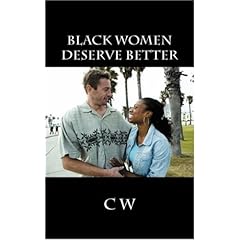
A picture says a thousand words


I just heard of this book by CW today. The cover pretty much sums up the depths of self-hated to which we have sunken. It's no secret that there is a gender war of sorts in the African-American community. Scores of us are verbally destroying our Brothers and Sisters in order to justify why we want to date anyone who isn't of our race. However, people who do this fail to realize that no matter how much they deride African-American (wo)men, they are pretty much shooting blanks as far as their argument is concerned. Here's why:

1. Let's just be honest. You just see European as better.
What all of these arguments come down to is a denial of racial bias. Rather acknowledging that they simply have a bias to Europeans, they put the blame on all of those of the opposite sex, saying that their in inadequacies forced them to find a mate outside their race. But anyone who is not in denial can see straight through this. We were all raised in this Euro-centric culture, so we know how you think. We were all trained to judged things by how white they are and only stop doing this when we recognize our behavior and work to correct it. But until we do, we chase after what closely matches the standard. I mean really, why choose an African-American, who doesn't come close to meeting the European Standard, when you can get the genuine item? Those who do this do not want to recognize their behavior, so in order to cover up their biases, they say that the other gender is responsible for their malicious feelings.

2. We come from the same origin.
I never understood how someone could rant about how terrible all African-American (wo)men were when we are raised in the same environments. It is not as if African-American women and men were born and raised on different planets. We grew up together in the same communities and cultures, so the bad soil that turned one of us rotten must have done the same to the other. Therefore, you can't act like the other gender is evil but yours is an innocent angel from heaven.

3. What Makes You Think the EA's Want You?
When you have so many problems with African-Americans, what makes you think that European-Americans wouldn't as well? If you don't respect African Americans, don't expect European-Americans to either.

4. Who made European-Americans demigods?
How can one find so many faults with African-Americans, but none with European-Americans at all? These African-American (wo)men bashers act as if choosing a EA for a mate will give them a flawless relationship straight out of a Disney movie and make their life complete. Their elevation of EA's to god-like perfection just illustrates their poor view of AA's. Secondly, since they love to talk about how superior EAs are a choice for mates, one must wonder what they do when talks about racism roll around. After all, it appears that EA's have more interest in AA's welfare than we do ourselves. They really have nothing to complain about.

What's truly ironic about this picture
Each time I hear someone insinuate that European-American men are better, such as in the cover of this book, the irony just sickens me. The author of this book says, "Black men are continuously being taught to disrespect, dishonor, and disregard the Black woman. The ugly, heartbreaking results manifest themselves with the 'baby mama' epidemic, video vixen mentality, enabling, denial, and other self-defeating behaviors." I agree with that statement, but what makes her think that EA men don't do the same? If your own people don't value you, why would you think that others do? In addition, who do does she think taught AA men to treat us this way? Who does she think taught us that EA women were valuable and worth protecting and reduced AA women to worthless objects? Who perpetuated, and continues to do so, this unbalanced image of EA and AA women in the media:

Choose your loyalties wisely.

As far as AA women bashing goes, it is shameful that men would turn their back on the only ones who stuck by them after 400 years of going through pure hell. How can anyone say such nasty things about AA women when their own sister and even their own mother is one. It reminded of a passage from the Adi Granth that criticizes this behavior well if you put it into the context of AA women:

We are born of woman,
we are conceived in the womb of woman,
we are engaged and married to woman.
We make friendship with woman
and the linage continued because of woman...
we are bound with the world though woman.
We grow up stronger and wiser having drunk milk from the breast of woman.
Why should we talk ill of her,
who gives birth to Kings?
The woman is born from woman;
there is none without her.
Only the One True Lord is without woman.

Natural Hair: My Road to Acceptance


I have made a couple of post about African-American women and our hair issues, but I have yet to share my own journey regarding how I have come to feel the way I do about my hair. My relationship with my hair has taught me many valuable lessons but one that I shall share here is: do not fit a square peg into a round hole.

When I Hated my Hair
My hair has never been permed or straightened at any point in my life, so during my childhood I always felt that my natural hair, in its pigtails, was a curse. The highest point in my elementary school career, during the third grade, was when I got braids for the first time. I was so proud that my hair could swig like "it should." However, my elation didn't last. My hair wasn't long enough. I knew that I couldn't get a relaxer because I had been told that they fry hair to death, and I definitely didn't want to look like the scores of girls I'd seen with relaxers so bad that it looked like their hair had been set on fire. The only option left for me was to get long braid extensions. Those were great to me. I had the long flowing hair without the pain of a relaxer. But they didn't appeal to me completely because I knew they were not equal to the Standard. So when I got older I was determined to get a weave (although I had no idea how weaves actually worked). I thought my natural hair was too long to wear a weave and wanted to cut it short. My mom thought I was crazy, but my reasoning was if you never wear natural hair out what is the use of it anyway? Besides that, I felt painfully embarrassed by hair. I could not go outside with it loose without my head being covered with a scarf or a hooded jacket. The only time I thought you were supposed to see it was when it was being "done" between extensions. (Looking back I think it is so sad that I thought that Black hair was so worthless that I was willing to cut it.) But back to the point, the extensions I had at this time looked too natural (everyone thought I had really long dreadlocks). Subconsciously, I knew I wasn't close enough to the Standard so I took the final step that would bring me closer to perfection. I got a sew-in, which was an ego boost for me (everyone would fawn over "my" hair). I finally had the hair that I'd ask God to miraculously change in elementary school. At the time, I did not make any connection between my relationship with my hair and any biases or prejudices I had against African features. If I heard anyone questioning why African-American women perm/press/weave our hair, I joined in with the scores of women saying it was because of convenience or citing that white women wear weaves too. However, even though my European-styled hair made me feel complete, I still felt uncomfortable. My mind was always on whether my tracks were showing and the like. Even though I felt pretty, I never felt right.

Turning Point
I realized that I was on a spiraling down on a path to no where when I heard a question by Malcolm X , "Who taught you to hate yourself?"


My initial reaction to this and of all of the others who had suggested that Black women who perm/press/weave had a problem was to reject the suggestion altogether. After all hair was just hair. White women style it however they want to, so why couldn't Black women? However, after examining the relationship I had with my hair I realized that it was never the case. From the moment that I became aware of its distinctiveness, I wanted to change it to something straighter or longer. If it was just hair, why did I try to hide it so much? In short, this question caused me to reexamine not only my views on my hair but society as a whole, but at this point, I will expound upon a single lesson that I gained from accepting my natural hair:

Black women as a group are like square pegs created in a society that is designed for round ones. We spend the majority of our lives chipping ourselves down, damaging ourselves mentally and physically, trying to make ourselves fit into a standard that wasn't set for us. I never was happy with my hair because I could was never equal to the Standard. I finally became content when I understood that my hair isn't supposed to look long and straight--that the rules for straight hair were completely different than those for mine. When I stopped seeing myself by how well I fit into European views, my eyes opened to how beautiful natural hair was. When I looked in the mirror, I stopped worrying "How can I get this straighter" or "How can I get my curls more defined." I realized that this is the way my coils are supposed to look and I will never be content if I try to make my it anything less than it is.

We cannot be truly happy or content with our lives until we come to the realization that there is a hole designed specifically for us to fit. When we chip ourselves down to fit the standard for someone else, we are only damaging ourselves.

Scientist Are Working to Cure Our Hair

I recently read on Essence that an Australian scientist is working to develop a pill that will make curly hair straight. This isn't new, however. Five years ago, ABC reported that L'Oreal researchers are creating a pill that will do the same. Apparently, these pills could replace relaxers and flat irons one day, but as Tia Williams pointed out, as scientist isolate the gene that makes our curly, it may eventually be removed altogether.

Our efforts to integrate diversity in our culture are being counteracted by this type of "progress." Why should we face the stigma our natural hair has when it is becoming increasingly easier just to chemically alter it in order to forget that we weren't born with what the world labels a genetic mistake. Instead of teaching society to embrace genetic diversity, we will jump at the chance to consume a product that brings us closer to the European standard. To make matters worse, as more of us transform ourselves to look European, we support the fear and ridicule of natural hair, reducing it to nothing more than being something foreign or a relic of the 70s. In fact, it practically is already. For example, why is it okay for white people to wear huge afro wigs in an effort to look clownish when it is offensive for them to go in blackface to look silly or pull their eyes mocking Asians. Blacks have no problem allowing them to mock our hair because we continuously try to separate ourselves from it. The uniqueness, respect, and beauty of our natural hair will continue fade as producers make products to match our cravings for straight hair.

Another consequence of this our powerful urge to assimilate and conform is a uniform dull world (sort of like the extreme society that is painted in "Eye of the Beholder"). As skin lighteners, hair straighteners, and surgical procedures bring cultures around the globe closer to a single ideal, encouraging us to lose appreciation for racial diversity, we create a world where everyone has similar features. How beautiful would the world be if it lacked its variety?


On a side note, this article from Essence reminded me of the Coil Review's excellent commercial:


Black People Have No Pride: Introduction

People often ask why did all of the progress stop after the 70s? Why did we lose our pride then? How did all of these problems suddenly crop up? It's amazing how Blacks did a 360 from being pro-Black to being what we are today, in such a short period of time. It's not just that we stopped being pro-Black. We lost any and all self-respect that we had.

Is there any other race that belittles itself to the extreme that we do? I don't see white people running around and calling themselves honkies and crackers. Asians don't call themselves chinks. Black people are the only people who use terms that were meant to dehumanize us as if they were badges of honor, or worse, we use them to disparage other black people. We have no problem degrading black women. When Malcolm X said in the 60's that "The most disrespected person in America is the Black woman, the most unprotected person in America is the Black woman, the most neglected person in America is the Black woman." I wonder if he would have thought the Black people would be perpetrators of this in 09'.

Furthermore, we've just stopped caring when people disrespect us. Starting since 2008 with Tropic Thunder, blackface has seen a revival, and this time Black people are laughing right along with the white. We think that our portrayal in Transformers is acceptable. When we laugh at "comedy" such as the Cleveland's and the Madea movies that make a mockery out of black ignorance, the joke is ultimately on us.

I believe that these and the majority of problems in Black America stem from an overall lack of respect for ourselves--it's beyond self-hatred. I don't even think this problem came so much from slavery, but from assimilation into white culture and from adopting white values. I'll be examining this in my next post, but for now, let me know what you think. What was the biggest cause of our overall lack of self-respect?

Black women need to be more independent

I know the above statement may seem to be overkill. Black women are stereotyped to be too independent. However, I do not believe this is true, and if it is, it is certainly not a bad thing.

Black women are way too hung up on what everyone thinks about us, and we should complain less about being undermined by society and the media. This is America. Don't expect it to hold you above the light-skinned girl above you. However, many black women act under the assumption that America will come around, and the black women will be glorified along with white. The problem is you can not live by wishful thinking or by your opinion of what America should be or what America should do. Stop expecting America to give black women justice.

Those who make such assumptions allow their self-concept to be defined by whether society gives them its stamp of approval or not. It then negatively affects their self-esteem when black women are persecuted because they take it personally. One thing black people fail to understand is that as long as aspects of your life rely on the majority's acceptance, you are still under their control. Black women should follow the John's advice of "being in the world [or America in this case] but not of it." We should not allow America's injustices to affect us to the point so that we conform to it.

Black women are at the bottom of the barrel in every aspect of American culture. Therefore, it is impractical to remain a part of such a system. I often hear black girls complain that white guys don't like them as they like white girls (not as if these black girls should be worried about getting white approval anyway), but they fail to realize that they are operating in a system that was designed to uplift the white woman and demean the black woman. That's why you are still not appreciated in the media, even though you straighten your hair, bleach your skin, or wear color contacts. The black woman will never be appreciated the way that the white woman is, so stop trying to be. Don't try to be the way that she is and find your own path. We need to find non-conventional goals that works for us. Think of it this way, when lab rats realize that there isn't cheese in a certain part of the maze, do they continue to return to it? They try to find cheese in a different location. Black women keep returning to an empty slot hoping that "cheese" is there, when we need to find fulfillment in places the that we aren't now.

In addition, black women should stop worrying so much about what men think and getting married, especially since black women aren't in demand by men anyway , it is wasted effort. I'm not saying that black women should give up on men or love. I'm just saying that this IR movement among black women is misplaced effort. Date, absolutely, but dating shouldn't be our main goal, and neither should be being accepted. We need to learn skills that enable us not to only survive but to thrive in a racist society. An example of this how the Koreans took over the black hair market. That was a great opportunity to add more power to our community by creating a market that made by black people and target to black people. Instead, our desire to conform to white standards was exploited and a $9 billion dollar industry is going to people who could care less about us. Imagine if we took all of that money that we spend to conform and used it to empower ourselves.

Focus on ending things that matter like black ignorance. Stop worrying about men and dating. Stop worrying about the stand of beauty. Most importantly get out of the Eurocentric mode of thinking because you will always be at the bottom rung of its social ladder if you operate under it.

Why Hair Matters

This is partly a response to AJR's post where she says how she's sick about the politics of Black hair, and that hair shouldn't matter. I disagree.

Now first of let me say that I don't think it's a sin to press hair or to wear a weave. I don't think that there is anything wrong with changing it up hear and there. However, I do not think that it is "healthy" for Blacks to chemically alter our hair or to always hide it with a weave.

The first thing many women will say to defend their non-natural state is that white women perm, press, curl, and weave up to. However, they fail to recognize that that we are not white. Black women and white women are not in the same situations, are not viewed the same way, and are not held to the same standard, so white women can not possibly be used to justify black hair choices. White women have been romanticized as Cleopatras and Aphrodities for ages. Black women have been forced to be Aunt Jemima's through the years. As a result, white women's hair choices don't impact them the way that black women's do. Most white women don't pretend to have an afro through childhood, and when I see pictures of whites trying to look silly, I see them wearing afro wigs, not long flowing blond hair. Black hair has a stigma. What percentage of black women do you think would walk down the street with an afro?

Anytime that someone puts significant time, effort, and money to change something, it matters. Anytime a portion of a population alters itself to look like the majority, it matters.
If you would never wear your hair in its natural state, hair matters to you.

Hair is not irrelevant because it is a reflection of culture and therefore a reflection of self. What do you think when you see a woman walking down the street in a sari ? You know she has Indian heritage, and any other perceptions you have about her are subject to your possible prejudices about Indians. Likewise, when many people see women in scarfs or burqas, they assume that they are oppressed or think little of themselves. What do people think when they see a woman in an afro. People frequently say that she looks uneducated, unprofessional, or something similar. This is because they recognize an afro as being a Black feature and since one has Black features she must also carry the negative attributes of Blacks.

We're all aware that Black characteristics carry strong negative connotations around the world. Therefore, the more "Black" one looks, the more these negative undertones will be attributed to that person. This is why people bleach their skin. This is why people straighten their hair. We do not choose our hair styles at random because they matter. We not only pick the styles we like based on our own preferences, but the preferences of others. People naturally want to be accepted by other's, and if that means changing themselves to look more white, they will do so. It's important to know why we make our decisions. Every choice we make is relevant because it is based on something learned. This includes hair styles.

Chris Rock Is Not in Black Women's Best Interest

My perception of people is generally negative, positive, or neutral. Chris Rock was in neutral status, until he produced Good Hair. When I saw the trailer, I was extremely disappointed. It didn't address the politics of Black hair. On the contrary, Chris Rock decided to use the emotional confusion that Black women experience with our hair and capitalize on it. I have been intensely following this Good Hair since it was announced, and I have come to the conclusion that Chris Rock does not respect black women nor is he trying to help black people with this film. He's just as caught up in the concept of good hair as all of us, and has no intention of tearing down Blacks' mental chains. This movie has no other purpose than to entertain whites.

Chris Rock Does Not Respect Black Women
I'll start this from a quote from the man himself:
Barack Obama has a black wife. And I don't think a black woman can be first lady of the United States. Barack has a handicap the other candidates don't have: Barack Obama has a black wife. And I don't think a black woman can be first lady of the United States. Yeah, I said it! A black woman can be president, no problem. First lady? Can't do it. You know why? Because a black woman cannot play the background of a relationship. Just imagine telling your black wife that you'e president? "Honey, I did it! I won! I'm the president." "No, we the president! And I want my girlfriends in the Cabinet! I want Kiki to be secretary of state! She can fight!"
The comment pretty much speaks for itself. Here, Rock is making his sister, a woman who has more education than he will ever have, sound ignorant simply because she is a Black woman. Brava, Chris Rock.

Apparently, black women are stupid and self-absorbed, which is funny. So it makes sense to make a movie out of that. So hear we have a movie mocking black women spending so much time, effort, and money making our hair texture look like someone else's. We're even buying someone else's hair and installing it into our own, and it's...hilarious? Really? According to Chris Rock, this is all a joke. He doesn't address that a whole race of women wouldn't do this for so many decades for no reason. He does not discuss the "why." He does not about talk where this mentality comes from. (He avoids this topic completely because he doesn't want to make his white audience upset but rather amuse them.) There is obviously something seriously wrong if a whole race of people are ashamed of their hair texture. The A.V. Club made great points:

The film is filled with sadly telling moments, like a black beauty student telling Rock that she'd have a hard time taking a job applicant seriously if he had an afro, yet its tone is one of amusement rather than indignation. Rock is an entertainer, not a polemicist, and Good Hair will never be mistaken for a college course in African American Hair And Racial Identity, though it does stress the pain women will endure and the exorbitant prices they'll pay to keep up with follicular trends. To the film's subjects, paying thousands for a complicated, high-maintenance weave is less a luxury than a necessity, even for those low on the socio-economic scale.

In order for Chris Rock to make a movie mocking Black women's insecurities this way, he must have little respect for us. In addition, in order for him to think that it's hilarious that Blacks believe that wearing our natural hair is so unacceptable that we must change it, shows me that he has little respect for his own people. I started to realize this even more after he was on the Oprah show. He could not get his fingers out of her hair, and was practically worshiping it on stage. He then said that Stedman was a lucky man. To make matters worse, he calls Oprah's natural hair "slave hair." And he wonders why his daughter was crying? Give me a break! I remember seeing him have a similar reaction when having an interview with a white woman. He didn't touch her hair, but he stated how he would love to run his hands through it and was practically drooling. Chris Rock believes in "Good Hair" as much as any other Black person.

I also hate how he avoids the real issue behind this "good hair" sentiment among Blacks, and maintains this "It doesn't matter what hair style you have, as long as you like it " stance. If that is true, what was the point of laughing at all of these women for perming and weaving in this movie? The only thing that he did was state the obvious. Black people know what we do to our hair. This was only an eye-opener for the whites, and it was for their entertainment. Of course, they thought it was hilarious how all of these Negroes are changing themselves to look like them. That's was the point of this film, to amuse the white man at the black woman's expense.
top